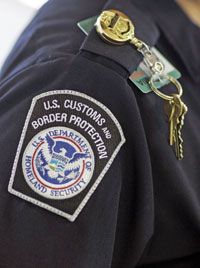
A woman stands in line at the airport, waiting to get through customs to return to the United States. She checks her BlackBerry for e-mail messages and shifts her computer briefcase to her other hand. Two uniformed men walk up to the traveler and ask her to step out of the line. They explain they're conducting a random search and that they need to look at her phone, her laptop and any other electronic devices she has. The woman asks when she can expect her property to be returned to her. The men in uniform tell her they can't be sure; they'll return the electronics when they're done searching.
According to the 9th Circuit Court in San Francisco, such a scenario is not only possible, it's completely legal. Federal Customs and Border Patrol agents have the right to confiscate and examine electronic devices belonging to anyone entering the United States. The agents aren't required to have probable cause before searching someone's devices. And they can look for any evidence of any crime at all.
Advertisement
This policy worries many international businesses that employ people who travel to and from the United States on a regular basis. It also might come as a shock to many U.S. residents. In most cases, citizens are guaranteed protection against unreasonable searches and seizures. Some people say that a policy in which a government agent could confiscate any electronic device for an indefinite length of time with no probable cause contradicts the Fourth Amendment of the U.S. Constitution. The 9th Circuit Court seems to feel otherwise.
U.S. Homeland Security officials claim that the policy is in place to protect the safety of the nation. They also claim that agents will not profile passengers or stop people based solely on their ethnic background or country of origin. But some critics say that in practice agents seem to target people from specific countries. An article in The Seattle Times suggests that government agents focus on Muslims and people from the Middle East or the southern parts of Asia more than others [source: Tu].
Border searches fall under the category of delicate issues -- proponents point out that an effective search might save millions of lives while critics say the potential for policy abuse is far too high to justify such an approach.
Advertisement