Cooling with Liquid

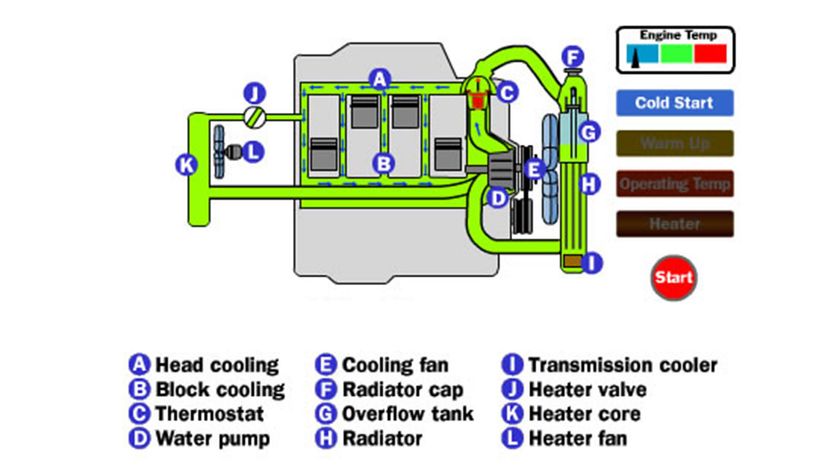
A liquid-cooling system for a PC is a lot like a cooling system for a car. Coolant flows through channels in a car's engine block, and the rest of the cooling system incorporates:
  • A pump that moves coolant through the system
  • A radiator that dispels heat into the air
  • A fan that moves air over the radiator
  • A coolant reservoir that holds extra fluid and allows easy addition of coolant
  • Hoses that connect the different parts of the system

water blocks
Image courtesy Darrin Gatewood
These water blocks can cool a GPU, a CPU and a northbridge.

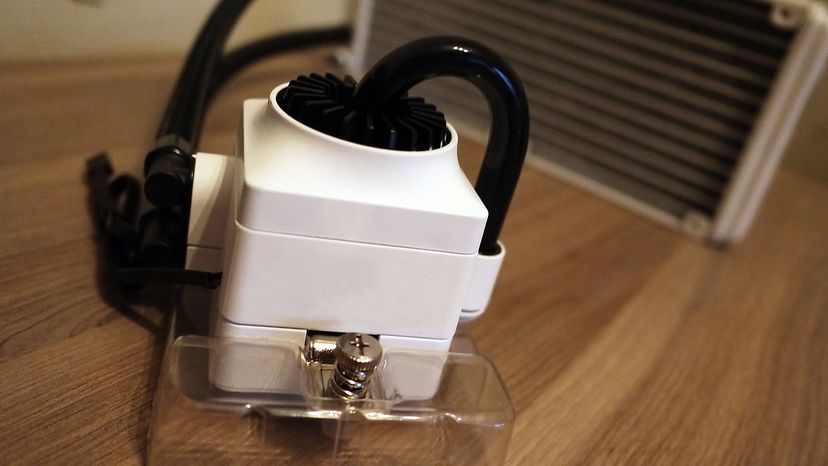
Many electronic components do not tolerate direct contact with liquid. So instead of using channels to pump liquid directly through microchips as in a car engine, a liquid-cooled PC uses water blocks. A water block is a piece of heat-conductive metal, like copper or aluminum, that's filled with hollow tubes and channels. The bottom of the water block is a flat piece of metal that sits directly on top of the chip being cooled. Thermal paste between the chip and the block improves the heat transfer between the two surfaces. The chip heats the block, and the water absorbs the heat as it flows through all the channels.

Many central processing unit (CPU) water blocks are universal, but some graphics processing unit (GPU) water blocks only work with specific chips. You can also find water blocks designed to cool other high-temperature chipsets, like the northbridge, which connects your CPU to your memory. Usually, small bolts and washers attach the water block to the necessary printed circuit board (PCB), such as the motherboard or video card.

The rest of a liquid-cooling system's components are much like those found in a car's cooling system. Most liquid-cooled PCs have:

  • A pump
  • A radiator
  • A fan
  • A coolant reservoir
  • Tubing

A centrifugal pump like the one used in your car
The pump is usually a centrifugal pump, much like you'd find in a car's cooling system. Some liquid-cooling pumps are submersible, and you can place them directly inside the coolant reservoir. Others need to be kept dry. If you're thinking about using a submersible pump, make sure its exterior doesn't get hot enough to heat all the fluid in the reservoir.

The pump is one of the most important parts of the system. Its flow rate determines how quickly the coolant moves through the tubes and blocks. If the water moves too quickly, it doesn't have time to absorb heat before moving on. If it moves too slowly, too much heat can build up around sensitive components. The complexity of the system affects the overall flow rate – the more resistance the fluid encounters within the blocks and radiator, the slower the overall flow rate.

The pump also has to be strong enough to move the liquid from the lowest point in the system to the highest. This is known as head pressure or vertical pressure, and it's especially important when liquid cooling tall server towers.

A pump for a liquid-cooled PC.
Image courtesy Amazon.com
A pump for a liquid-cooled PC.

The system's radiator can be designed specifically for liquid-cooling systems, or it can be the heater core from a car. Heater cores dispel lots of heat – they provide the warm air for a car's heating system in the winter. However, they're not usually as attractive as radiators that are designed for use with a liquid-cooling system.

Not every liquid-cooled system has a fan, but most use one to help the radiator dispel heat faster. Similarly, not every system has a separate reservoir. Those that don't generally have a fill/bleed line for adding coolant and removing extra air from the system. Usually, the fill/bleed line leads to a filling port at the top of the computer's case.

cooling reservoirs in a computer's drive bay
Image courtesy Darrin Gatewood
Many cooling reservoirs fit into a computer's drive bay.

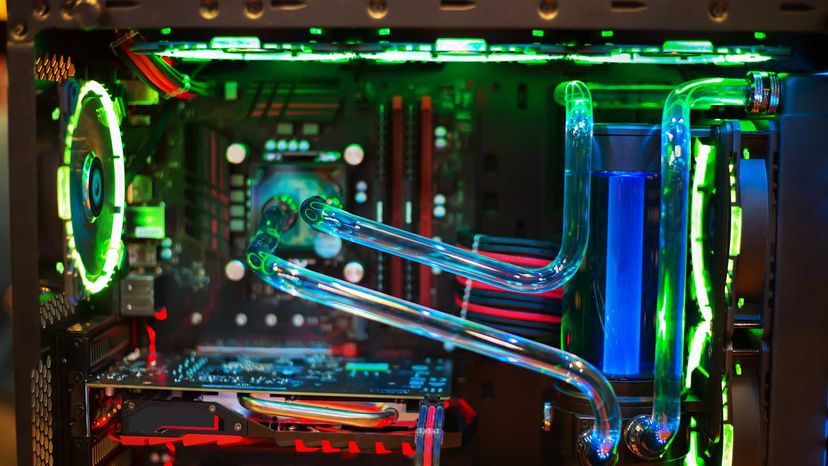
In a liquid-cooled PC, the tubing presents a special challenge. It has to be flexible enough to connect components that may be at odd angles to one another. But it can't be prone to kinking – a kinked hose can severely restrict the flow of fluid through the system.

In a simple system, a tube connects the pump to the inlet of a water block. Separate tubes run from the water block's outlet to the radiator and the radiator to the reservoir, which often sits in one of the computer's CD-ROM bays. The final tube connects the reservoir back to the pump. For systems with multiple water blocks, tubes connect one block's outlet to the next block's inlet, connecting the blocks in series like a daisy chain.

Deep-fried PCs?
A Pentium I 166 MHz machine cooled with cooking oil
Image © 2003 Ebo Eppenga

Many electrical components can short-circuit when exposed to liquid, but some liquids can both dispel heat and act as electrical insulators. One such liquid is cooking oil. Check out what happens when you submerge a computer in oil at the Toms Hardware site or at Eppenga.com.

The final component of a liquid-cooling system is the liquid itself. Many people use distilled water, since tap water contains contaminants that can cloud the system or clog the channels in the water blocks and radiator. Specialized additives can add color to the fluid, making it more visually appealing when used in a clear case. They can also lower the freezing point or surface tension of the water, making it a more effective coolant. Finally, some additives have antimicrobial or anti-corrosion ingredients, which can increase the life of the system.

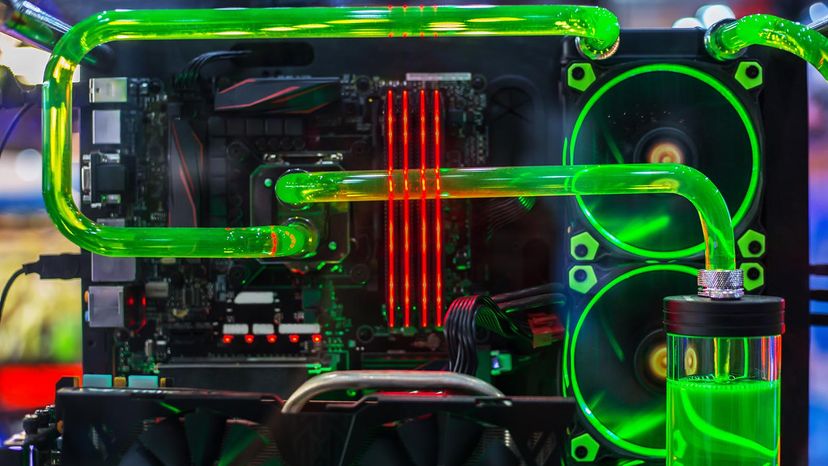
tubes carry coolant to and from water blocks
Image courtesy Darrin Gatewood
In an operational system, tubes carry coolant to and from water blocks.

If you decide to install a liquid-cooling system in your computer, it's a good idea to let the pump circulate the fluid for a while so you can check for leaks. Keep your computer turned off during this test period so you'll be less likely to damage your hardware if a leak does occur.

Once you're sure that everything is watertight, boot up the computer. You can check the temperature of your components in your computer's BIOS menu or by using a third-party application that monitors temperature. If necessary, you can also apply smaller heat sinks to RAM chips and other higher-temperature components in your system.

Check out the links on the next page to learn more about PCs, thermodynamics, liquid-cooled computers and related topics.

When Water Just Isn't Cold Enough
If you want to cool your PC's parts even more than a liquid-cooling system will allow, you can use Peltier devices in place of standard water blocks. A Peltier device is a thermoelectric device. When you apply electricity to it, heat moves from one side to the other. In other words, one side of the Peltier device gets very cold while the other gets very hot. The cold side of the Peltier device can cool a microchip, while water from the liquid-cooling system draws the heat away from the hot side.

Some people prefer systems that use these devices because they cool a PC's components well below ambient temperature. However, they do require extra precautions. Since the cold side of a Peltier device is colder than the surrounding air, it's prone to accumulating condensation. Without ample protection against condensation, a Peltier system can lead to a short circuit.