NAT Configuration
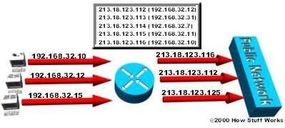
NAT can be configured in various ways. In the example below, the NAT
router is configured to translate unregistered (inside, local) IP
addresses, that reside on the private (inside) network, to registered
IP addresses. This happens whenever a device on the inside with an
unregistered address needs to communicate with the public (outside)
network.
- An ISP assigns a range of IP addresses to your company. The
assigned block of addresses are registered, unique IP addresses and are
called inside global addresses. Unregistered, private IP addresses are split into two groups. One is a small group (outside local addresses) that will be used by the NAT routers. The other, much larger group, known as inside local addresses, will be used on the stub domain. The outside local addresses are used to translate the unique IP addresses, known as outside global addresses, of devices on the public network.

IP addresses have different designations based on
whether they are on the private network (stub domain) or on the public
network (Internet), and whether the traffic is incoming or outgoing.
|
- Most computers on the stub domain communicate with each other using the inside local addresses.
- Some computers on the stub domain communicate a lot outside
the network. These computers have inside global addresses, which means
that they do not require translation.
- When a computer on the stub domain that has an inside local
address wants to communicate outside the network, the packet goes to
one of the NAT routers.
- The NAT router checks the routing table to see if it has an
entry for the destination address. If it does, the NAT router then
translates the packet and creates an entry for it in the address
translation table. If the destination address is not in the routing
table, the packet is dropped.
- Using an inside global address, the router sends the packet on to it's destination.
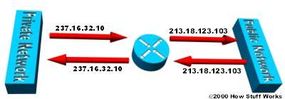
- A computer on the public network sends a packet to the private
network. The source address on the packet is an outside global address.
The destination address is an inside global address.
- The NAT router looks at the address translation table and
determines that the destination address is in there, mapped to a
computer on the stub domain.
- The NAT router translates the inside global address of the
packet to the inside local address, and sends it to the destination
computer.
NAT overloading utilizes a feature of the TCP/IP protocol stack, multiplexing, that allows a computer to maintain several concurrent connections with a remote computer (or computers) using different TCP or UDP ports. An IP packet has a header that contains the following information:
- Source Address - The IP address of the originating computer, such as 201.3.83.132
- Source Port - The TCP or UDP port number assigned by the originating computer for this packet, such as Port 1080
- Destination Address - The IP address of the receiving computer, such as 145.51.18.223
- Destination Port - The TCP or UDP port number that the originating computer is asking the receiving computer to open, such as Port 3021
The addresses specify the two machines at each end, while the port
numbers ensure that the connection between the two computers has a
unique identifier. The combination of these four numbers defines a
single TCP/IP connection. Each port number uses 16 bits, which means
that there are a possible 65,536 (216)
values. Realistically, since different manufacturers map the ports in
slightly different ways, you can expect to have about 4,000 ports
available.