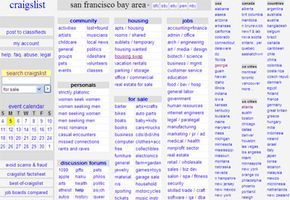
Craigslist.org, originally a San Francisco community electronic newsletter, is now one of the most visited English language Web sites, with local classifieds for more than 450 cities worldwide. The site's main function is to host classified ads that cover practically every category you can think of, including housing, job postings, items for sale, services and personals. There's also a forums section that allows users to discuss topics on everything from gardening to the Linux operating system.
Craigslist's founder Craig Newmark and CEO Jim Buckmaster aim to provide users with a helpful, noncommercial way to connect with other people in their communities [source: New York Times]. Posting for most classifieds categories on craigslist is free, and it's also free to browse and respond to ads. The Web site doesn't have any flashy animation or graphics -- its value comes from its utilitarian design and the contributions of its users.
Advertisement
If all you want to do is browse the site, you can just visit craigslist.org and click away. The site has a range of broad categories, and each category has several subcategories, making it easy to navigate to the appropriate section quickly. For example, the "for sale" category features subcategories like computer, books, electronics, sporting, motorcycles and collectibles, among others.
Most ads include the member's e-mail address. Craigslist offers a function that masks e-mail so that members don't have to worry about their address being openly available. All transactions are between the person who posted the ad and the person responding to it. Craigslist's employees don't get involved in any transactions or discussions unless someone reports a problem.
If you want to participate in forum discussions or post your own classifieds, you need to create a craigslist account. The only thing you need to become a member is a valid e-mail address. The signup process is short and painless -- after entering your e-mail and filling in a verification word (which helps prevent programs called bots from creating accounts to post ads automatically), you'll receive an e-mail that includes a link you'll need to click on to verify your account and log in. Once you've done that, you've officially joined the craigslist community.
Craigslist users act like the site's watchdogs by monitoring the content that gets posted. Users flag posts to draw attention to those that are particularly interesting and those that detract from the site. The tags that can be applied to posts are best of craigslist (a funny or effective post), miscategorized (a post placed in the wrong section of the site), spam/overpost (a generic post or one that has been posted multiple times) and prohibited (a post that directly violates the site's terms of use).
In this article, we'll look at craigslist's impact on the Internet, the corporate structure of the company and some of the controversies involving the Web site.
In the next section, we'll learn about craigslist's presence on the Web.
Advertisement