
Bridges
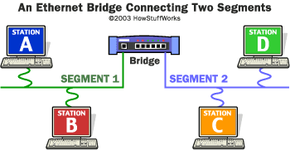
To alleviate problems with segmentation, Ethernet networks implemented bridges. Bridges connect two or more network segments, increasing the network diameter as a repeater does, but bridges also help regulate traffic. They can send and receive transmissions just like any other node, but they do not function the same as a normal node. The bridge does not originate any traffic of its own; like a repeater, it only echoes what it hears from other stations. (That last statement is not entirely accurate: Bridges do create a special Ethernet frame that allows them to communicate with other bridges, but that is outside the scope of this article.)
Remember how the multiple access and shared medium of Ethernet meant that every station on the wire received every transmission, whether it was the intended recipient or not? Bridges make use of this feature to relay traffic between segments. In the figure above, the bridge connects segments 1 and 2. If station A or B were to transmit, the bridge would also receive the transmission on segment 1. How should the bridge respond to this traffic? It could automatically transmit the frame onto segment 2, like a repeater, but that would not relieve congestion, as the network would behave like one long segment.
Advertisement
One goal of the bridge is to reduce unnecessary traffic on both segments. It does this by examining the destination address of the frame before deciding how to handle it. If the destination address is that of station A or B, then there is no need for the frame to appear on segment 2. In this case, the bridge does nothing. We can say that the bridge filters or drops the frame. If the destination address is that of station C or D, or if it is the broadcast address, then the bridge will transmit, or forward the frame on to segment 2. By forwarding packets, the bridge allows any of the four devices in the figure to communicate. Additionally, by filtering packets when appropriate, the bridge makes it possible for station A to transmit to station B at the same time that station C transmits to station D, allowing two conversations to occur simultaneously!
Switches are the modern counterparts of bridges, functionally equivalent but offering a dedicated segment for every node on the network (more on switches later in the article).