Step Two: The Press Run
The printing process used to print How Stuff Works Express is called web offset lithography. The paper is fed through the press as one continuous stream pulled from rolls of paper. Each roll can weigh as much as 2,000 pounds (1 ton). The paper is cut to size after printing. Offset lithography can also be done with pre-cut paper in sheetfed presses.Web presses print at very high speeds and use very large sheets of paper. Press speeds can reach up to 50,000 impressions per hour. An impression is equal to one full press sheet (38 inches x 22 and three-fourths inches), which is 12 pages of How Stuff Works Express.
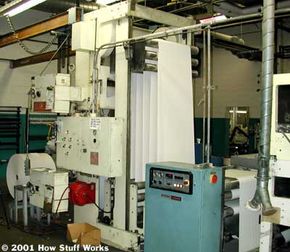
![]() Web-press paper-feed system showing the double roll of paper just before the splice from the smaller roll (on the bottom) to the larger roll. Each roll of paper weighs nearly 1 ton and is sufficient for 9,000 impressions (72,000 printed pages). |
Even when a 1-ton roll of paper runs out, the presses do not stop rolling. Rolls can be spliced together as the web press is running by using festoons. Festoons are a series of rollers that extend up into a tower. A few moments prior to the splice occurring, the festoons will move up into the tower, pulling in large amounts of paper. At the moment the splice occurs, the rolls of paper stop rotating for a split second, at which point the paper is taped together automatically. As the newly spliced roll begins to pick up speed, the festoons begin to drop out of the tower at a rate predetermined by the speed at which the press is operating. The press operator never has to adjust the press controls during this operation.
![]() Festoons are a series of rollers used to adjust tension before and after the splice from a small, fast-turning roll of paper to a large, slow-turning roll of paper. |
The press has to maintain a constant balance between the force required to move the paper forward and the amount of backpressure (resistance) that allows the paper to remain tight and flat while traveling through the equipment.
The Inking Process
Ink and water do not mix -- this is the underlying principle of offset lithography. The ink is distributed to the plates through a series of rollers. On the press, the plates are dampened, first by water rollers, then ink rollers. The rollers distribute the ink from the ink fountain onto the plates.
The image area of the plate picks up ink from the ink rollers. The water rollers keep the ink off of the non-image areas of the plate. Each plate then transfers its image to a rubber blanket that in turn transfers the image to the paper. The plate itself does not actually touch the paper -- thus the term "offset" lithography. All of this occurs at an extremely high speed.
![]() Close-up of rollers. The top series of rollers transfers the yellow ink to the rubber "blanket" cylinder (bottom roller), and then to the paper that is passing horizontally under the "blanket." |
The paper is left slightly wet by all of the ink and water being applied. Obviously, there is a risk of the ink smudging. The smudging is avoided by having the paper pass through an oven. The oven is gas fired, and the temperature inside runs at 350 to 400 degrees Fahrenheit (176 to 206 degrees Celsius).
![]() The paper is run through a long oven at about 375 degrees Fahrenheit (190 degrees Celsius). This dries (sets) the ink so it won't smudge. |
Immediately after leaving the oven, the paper is run through a short series of large metal rollers that have refrigerated water flowing through them. These chill rollers cool the paper down instantly and set the ink into the paper. If this were not done, the ink would rub off on your fingers.
Color and Registration Control
Color and registration control is a process that is aided by the use of computers. Registration is the alignment of the printing plates as they apply their respective color portion of the image that is being printed. If the plates do not line up perfectly, the image will appear out of focus and the color will be wrong. A computer takes a video image of registration marks that have been placed on the press sheet. Each plate has its own individual mark. The computer reads each of these marks and makes adjustments to the position of each plate in order to achieve perfect alignment. All of this occurs many times per second while the press is running at full speed.
![]() The RCS (Register Control System) provides constant adjustment of the press. The computer works in concert with a strobe light and video camera to constantly process information about color registration. Incredibly small adjustments, measured in the 1,000ths of inches, are automatically made to the color rollers to ensure proper registration. |
Color control is a process that involves the way in which the ink blends together, and is tied closely to the plate registration. The amount of ink that is released into the units depends on how much ink is needed to achieve a desired look. The ink is adjusted via the control panel that is part of the overall control console. Prior to being placed on the press, the plates are scanned and the data is then transferred to a micro cassette. This serves as the "master" that directs the release of ink to pre-set values.
![]() The web offset press that prints How Stuff Works Express is 115 feet long and weighs 500,000 lbs -- more than 150 Toyota Camrys! The process starts with a huge roll of paper that is fed through four banks of rollers. Each roller adds one color at a time, starting with black, then cyan (blue), magenta (red) and finally yellow. |
![]() Press speeds can run up to 50,000 impressions per hour. |
![]() Print quality is checked frequently by the press operator. |