Mention the history of the Internet to a group of people, and chances are someone will make a snarky comment about Al Gore claiming to have invented it. Gore actually said that he "took the initiative in creating the Internet" [source: CNN]. He promoted the Internet's development both as a senator and as vice president of the United States. So how did the Internet really get started? Believe it or not, it all began with a satellite.
It was 1957 when the then Soviet Union launched Sputnik, the first man-made satellite. Americans were shocked by the news. The Cold War was at its peak, and the United States and the Soviet Union considered each other enemies. If the Soviet Union could launch a satellite into space, it was possible it could launch a missile at North America.
Advertisement
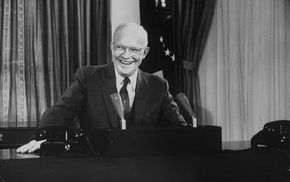
President Dwight D. Eisenhower created the Advanced Research Projects Agency (ARPA) in 1958 as a direct response to Sputnik's launch. ARPA's purpose was to give the United States a technological edge over other countries. One important part of ARPA's mission was computer science.
In the 1950s, computers were enormous devices that filled entire rooms. They had a fraction of the power and processing ability you can find in a modern PC. Many computers could only read magnetic tape or punch cards, and there was no way to network computers together.
ARPA aimed to change that. It enlisted the help of the company Bolt, Beranek and Newman (BBN) to create a computer network. The network had to connect four computers running on four different operating systems. They called the network ARPANET.
Without ARPANET, the Internet wouldn't look or behave the way it does today -- it might not even exist. Although other groups were working on ways to network computers, ARPANET established the protocols used on the Internet today. Moreover, without ARPANET, it may have taken many more years before anyone tried to find ways to join regional networks together into a larger system.
In the next section, we'll look at how ARPANET joined with other networks to create the Internet.
Advertisement