Introduction to How Kazaa Works
![]() Courtesy © Sharman Networks 2002-2004 - All Rights Reserved. |
Just a few years later, a more wide-sweeping file-sharing network, Kazaa (or KaZaA) emerged. Kazaa enables its users to share not only music, but also movies, television shows and other types of digital information. Kazaa soon became the most popular file-sharing service on the Internet, with millions of users simultaneously sharing content.
![]() Courtesy © Sharman Networks 2002-2004 - All Rights Reserved. |
But with unlimited file sharing comes the big question: Should users be granted unrestricted -- and free -- access to copyrighted movies, music and games? The recording and film industries continue to respond with a resounding "No." After being sued for copyright infringement by the Recording Industry Association of America (RIAA), the original Napster was forced to shut down; Kazaa now finds itself in similar hot water. So far, it has weathered the legal storm.
In this article, we'll find out exactly how Kazaa works, learn how its users share data across the Internet and examine why Kazaa has thus far survived the legal battle.
What is Kazaa?
|
|
![]() Courtesy © Sharman Networks 2002-2004 - All Rights Reserved. Kazaa users can search for various types of files. |
But today, despite its legal setbacks, Kazaa remains a thriving business with millions of users worldwide.
What Can Kazaa Do?
When users download Kazaa software, they can:
- Search for movies, music, TV shows and other content from Kazaa users, as well as from other content providers on the Internet
- Pull up as many as 3,000 results per search
- Download files simultaneously from several sources
- Promote their own content to other Kazaa users
Kazaa File Types
To search for a file on Kazaa, users type the name of the file they want into a box and hit search.
![]() Courtesy © Sharman Networks 2002-2004 - All Rights Reserved. |
Then they select the file they want to download from a list of results. They can select from two file types:
- Blue files are made up of content that is controlled by Kazaa users. People who make their content available on Kazaa can license it so that other users can't copy and distribute it without giving them credit. Blue files are free to download.
- Gold files contain content from movie studios, music labels and other providers who oversee the use of their material. Gold files are distributed via another P2P network called Altnet and are pay-per-download.
Kazaa is free to its users. The company makes money by running online ads, distributing special "Rights Managed" content (gold-icon files) and selling its products and services.
How Does Kazaa Work?
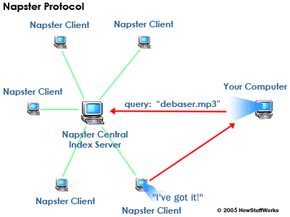
Kazaa uses peer-to-peer (P2P) file sharing -- the same type of technology that made Napster famous.
![]() Napster architecture |
But unlike Napster, which distributed content via a centralized server, Kazaa uses a decentralized system. Kazaa users contact one another directly online to share content. Kazaa's decentralization is one of the main reasons why it has weathered the legal firestorm this long.
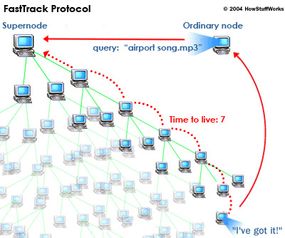
![]() Kazaa architecture |
To transfer data between users (peer-to-peer), Kazaa uses the FastTrack protocol. FastTrack is a so-called "second generation" P2P protocol. The system divides Kazaa users into two groups: supernodes and ordinary nodes. Supernodes are powerful computers with fast network connections, high bandwidth and quick processing capabilities (computer owners don't know that their computers have been designated as supernodes). The approximately 30,000 supernodes on Kazaa act a lot like traffic hubs, processing data requests from the slower ordinary nodes. Each supernode may serve between 60 and 150 ordinary nodes at one time.
When a user installs the Kazaa software on his or her computer, it comes coded with a list of supernodes. Every time the user launches the Kazaa application, his or her computer registers with the central server and then chooses from a list of currently active supernodes. When the computer sends out a request for files the user wants to download or upload, the request is funneled through the supernode. The supernode communicates with other supernodes, which in turn connect to regular nodes that in turn connect to even more regular nodes, to fulfill the request until the Time to Live of 7 runs out -- this means that the search request will extend seven levels into the network before it stops propagating. Once the correct file has been located, it is transferred directly from the file owner to the requester using HTTP (HyperText Transfer Protocol) -- it doesn't have to go through a supernode.
|
|
Is Kazaa Legal?
|
|
In 2001, Kazaa was sued by a Dutch music company and was ordered to stop its users from violating copyrights or face steep penalties. In response to the decision, Kazaa transferred ownership to offshore companies, primarily Sharman Networks Limited on the island of Vanuatu. But in 2002, a Dutch appeals court overturned the previous judgment, ruling that Kazaa was not responsible for the actions of its users (see afterdawn.com - Dutch appeals court: KaZaA is legal). Its decentralized structure means that Kazaa is not involved in the actual file sharing -- all searches and downloads take place between actual user computers. Later that year, Kazaa was sued again, this time in the United States by the Recording Industry Association of America (RIAA) and the Motion Picture Association (MPAA). As of February 2005, the decision in that suit is still pending.
Kazaa's argument that its decentralized setup frees it from liability was given a boost in 2003, when a U.S. District Court judge ruled that Grokster and Morpheus, two other file-sharing services, were not liable for their users' actions.
That leaves only the users themselves as liable for sharing copyrighted material. In 2003, the Recording Industry Association of American (RIAA) began targeting individual users with lawsuits. The RIAA didn't go after just anyone -- they zeroed in on people who had made thousands of copyrighted files available to other users. These repeat file sharers were identified by their IP address and hit with lawsuits ranging from $750 to $150,000. In October 2004, the International Federation of the Phonographic Industry (IFPI) similarly launched lawsuits against several hundred users of Kazaa and two other file-sharing services.
|
|
Privacy and Security Issues
Whenever you allow other users to pull information from your computer, or you pull information from another user's computer, you're opening the door to viruses, privacy invasions and a host of other security issues.To prevent downloading of sensitive information, Kazaa advises its users to set up a special "My Shared Files" folder on their desktop. Then, when people try to download a file, they can only have access to the shared folder, rather than being allowed to wander freely across the individual's hard drive. Kazaa also comes equipped with virus-protection software that weeds out some of the bugs floating around cyberspace.
|
|
For more information on Kazaa, file sharing and related topics, check out the links on the next page.
Lots More Information
Related HowStuffWorks Articles
- How File Sharing Works
- How Home Networking Works
- How Lawsuits Work
- How Music Licensing Works
- How the Old Napster Worked
More Great Links
- Kazaa
- ShareTheFiles.com
- SpywareInfo: Clean and Infected File Sharing Programs
- Slyck's Guide to FastTrack
Books
- Sonic Boom: Napster, MP3, and the New Pioneers of Music, by John Alderman
- Discovering P2P, by Michael Miller, Michael
- Peer-to-Peer: Harnessing the Power of Disruptive Technologies, by Andy Oram
- Steal This File-Sharing Book, by Wallace Wang
- MP3 Underground: The Inside Guide to MP3 Music, Napster, RealJukebox, MusicMatch, and Hidden Internet Songs, by Ron White (with CD-ROM)
Sources
- "459 European P2P users sued." AfterDawn.com, October 7, 2004
http://www.afterdawn.com/news/archive/5675.cfm
- Corder, Mike. "Recording Industry and File-Sharing Service Face Off in Australia," The America's Intelligence Wire, November 29, 2004.
- Evers, Joris. "Dutch Supreme Court Rules Kazaa Legal," PCWorld, December 19, 2003.
http://www.pcworld.com/news/article/0,aid,113968,00.asp
- "FastTrack," Free-Definition.
http://www.free-definition.com/FastTrack.html
- Kazaa
http://www.kazaa.com/us/index.htm
- "Kazaa Owner Complains of Copyright Infringement," Chilling Effects.
http://www.chillingeffects.org/dmca512/notice.cgi?NoticeID=789
- Liang, Jian, et al. "The KaZaA Overlay: A Measurement Study," Polytechnic University, New York, September 15, 2004.
- Liang, Jian, et al. "Pollution in P2P File Sharing Systems," Polytechnic University, New York.
http://cis.poly.edu/~ross/papers/pollution.pdf - Napster's Sons: Singing a Different Tune?" Business Week Online, February 21, 2002.
- "Sued for a Song," What's the Download.com.
http://www.whatsthedownload.com/whats_the_controversy/sued_for_a_song/index.aspx - Woody, Todd. "The Race to Kill Kazaa." Wired, Issue 11.02, February 2003.
http://www.wired.com/wired/archive/11.02/kazaa_pr.html