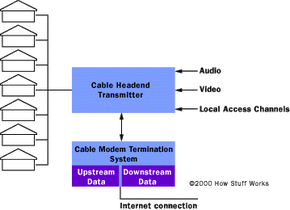
At the cable provider's head-end, the CMTS provides many of the same functions provided by the DSLAM in a DSL system. The CMTS takes the traffic coming in from a group of customers on a single channel and routes it to an Internet service provider (ISP) for connection to the Internet. At the head-end, the cable providers will have, or lease space for a third-party ISP to have, servers for accounting and logging, Dynamic Host Configuration Protocol (DHCP) for assigning and administering the IP addresses of all the cable system's users, and control servers for a protocol called CableLabs Certified Cable Modems -- formerly Data Over Cable Service Interface Specifications (DOCSIS), the major standard used by U.S. cable systems in providing Internet access to users.
The downstream information flows to all connected users, just like in an Ethernet network -- it's up to the individual network connection to decide whether a particular block of data is intended for it or not. On the upstream side, information is sent from the user to the CMTS -- other users don't see that data at all. The narrower upstream bandwidth is divided into slices of time, measured in milliseconds, in which users can transmit one "burst" at a time to the Internet. The division by time works well for the very short commands, queries and addresses that form the bulk of most users' traffic back to the Internet.
A CMTS will enable as many as 1,000 users to connect to the Internet through a single 6-MHz channel. Since a single channel is capable of 30 to 40 megabits per second (Mbps) of total throughput, this means that users may see far better performance than is available with standard dial-up modems. The single channel aspect, though, can also lead to one of the issues some users experience with cable modems.