Intellon and Intelogis use different methods to establish power-line networks.
Intellon
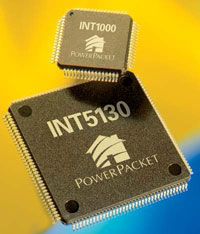
Intellon's PowerPacket technology, which serves as the basis for the HomePlug Powerline Alliance standard, uses an enhanced form of orthogonal frequency-division multiplexing (OFDM) with forward error-correction, similar to the technology found in DSL modems. OFDM is a variation of the frequency-division multiplexing (FDM) used in phone-line networking. FDM puts computer data on separate frequencies from the voice signals being carried by the phone line, separating the extra signal space on a typical phone line into distinct data channels by splitting it into uniform chunks of bandwidth.
In the case of OFDM, the available range of frequencies on the electrical subsystem (4.3 MHz to 20.9 MHz) is split into 84 separate carriers. OFDM sends packets of data simultaneously along several of the carrier frequencies, allowing for increased speed and reliability. If noise or a surge in power usage disrupts one of the frequencies, the PowerPacket chip will sense it and switch that data to another carrier. This rate-adaptive design allows PowerPacket to maintain an Ethernet-class connection throughout the power-line network without losing any data.
The latest generation of PowerPacket technology is rated at 14 Mbps, which is faster than existing phone-line and wireless solutions. However, as broadband access and Internet-based content like streaming audio and video and voice-over-IP become more commonplace, speed requirements will continue to increase. Along these lines, Intellon's OFDM approach to power-line networking is highly scalable, eventually allowing the technology to surpass 100 Mbps.
Intelogis
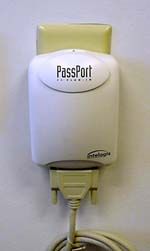
The older power-line technology used by Intelogis relies on frequency-shift keying (FSK) to send data back and forth over the electrical wires in your home. FSK uses two frequencies, one for 1s and the other for 0s, to send digital information between the computers on the network. (See How Bits and Bytes Work to learn more about digital data.) The frequencies used are in a narrow band just above the level where most line noise occurs. Although this method works, it is somewhat fragile. Anything that impinges on either frequency can disrupt the data flow, causing the transmitting computer to have to resend the data. This can affect the performance of the network. For example, this author noticed that when he was using more electricity in the house, such as running the washer and dryer, the network slowed down. Intelogis includes line-conditioning power strips with its network kit and encourages you to insert them between the wall outlet and your computer equipment to help reduce the amount of electrical-line noise.
Because the current crop of power-line networks are designed to work on 110-volt electrical systems, the technology is not very useful to countries outside of North America that use different standards.