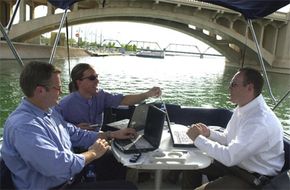
Users take advantage of a wireless network inTempe, Arizona. See more ways to go online with Internet connection pictures.
Photo courtesy City of Tempe
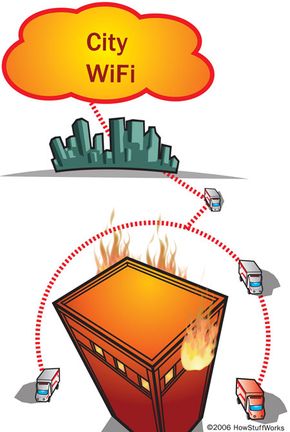
Imagine you're a reporter writing about a tense hostage situation, and you're on a tight deadline. You don't have time to drive back to your office, and if you leave you'll miss out on the developing story. Fortunately, you have wireless access to the Internet -- you can write and file your story without leaving the scene.
Part of your article describes how police have access to real-time feeds from security cameras. From their patrol cars, officers monitor the situation and access blueprints of the building, including its entrances, exits and hiding places. They use this information to plan what to do. They also have a secure network connecting them to a hostage negotiator.
Advertisement
When the situation is over, everyone believes this municipal wireless network and the information it carried helped lead to a peaceful resolution.
In this article, you'll learn about the amazing things that these networks can do -- besides potentially providing free or cheap Internet access. You'll also learn about the technology behind them and why "Municipal WiFi" can be a misnomer.
Different Cities, Different Models
The first thing some people think of when hearing that a city is planning a municipal network is "free access." This isn't always -- or even often -- the case. Here are some examples of what some cities are doing with their networks:
Philadelphia, Pennsylvania: Philadelphia wanted to bridge the digital divide, so its network provides low-cost access for everyone and discounted access for low-income families. When the network is finished, EarthLink will provide wholesale access to other ISPs.
St. Cloud, Florida: St. Cloud has free access for everyone, and its network is complete and running.
Corpus Christi, Texas: After a dog attacked a meter reader, Corpus Christi decided to automate its meter-reading systems. The city is gradually adding other capabilities to the network.
The early days of home Internet access required using a modem connected to a computer to dial a number and maintain a connection. It was cumbersome and slow. The faster modems became, the more people realized how painfully sluggish data transmission had been in the days of 300 baud. Eventually, home users who could afford a jump in price could get broadband access via digital subscriber lines (DSL), cable
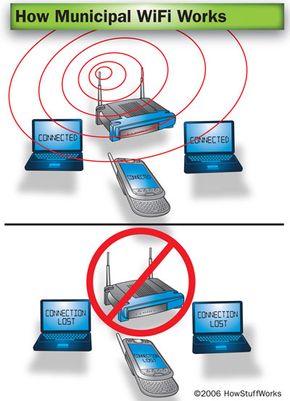
Broadband access is faster than dial-up, but until recently you still to plug your computer into a wall jack or a piece of equipment. Wireless networking, or WiFi has changed all that. Wireless networks use 802.11 networking standards to allow devices to communicate. In a WiFi network, data travels from place to place via radio waves. You still have to physically connect a wireless router to a modem, but you can move your computer from place to place.
802.11 networking uses the unlicensed radio spectrum to send and receive data. Many other parts of the spectrum, such as the bands that carry radio and TV signals, require a license to use. The unlicensed spectrum is accessible to anyone who has the right equipment. In the case of wireless computer networking, that's a wireless router and wireless technology in the device you're using.
Since 2002, many people have set up wireless networks in their homes. Businesses have done the same, giving their employees additional mobility. Public gathering places, like coffee shops, parks and libraries, have created WiFi hot spots, hoping to draw in additional businesses. The number of public hot spots has grown rapidly -- analysts estimate that there will be 200,000 of them by 2008 [ref].
Now, cities have begun setting up municipal wireless networks. As of January 2006, 186 United States cities had their networks up and running or had definite plans to build one. That's up from 122 cities in the previous July [ref]. Some of these networks provide high-speed Internet access for free, or for substantially less than the price of other broadband services. Others are for city use only -- they allow police and fire departments and other city employees to do certain aspects of their jobs remotely.
Cities currently proposing networks have several goals. They want to improve worker productivity, make the city more attractive to businesses, bolster the economy, bridge the digital divide or do all these things with one network. The United States is also 16th in the world in broadband penetration, which some leaders believe is a sign that the nation is falling behind [ref]. A wireless network might make broadband access more available and affordable for more people.
Often called "municipal WiFi," these networks use more than just 802.11 networking. A wireless access point in a municipal network is also different from a typical WiFi hot spot. Next, we'll look at the "mesh" that makes a wireless network.
Wireless Standards
Wireless networking uses a range of standards -- the rules that routers and receivers use to communicate with each other. Most common are:
802.11a - 54 Mbps data rate in the 5 GHz band of the radio spectrum
802.11b - 11 Mbps, 2.4 GHz
802.11g - 54 Mbps, 2.4 GHz
802.11e - 54 Mbps, 2.4 GHz, with quality of service (QoS) protocols, which should improve VoIP and streaming media quality
A separate standard, 802.16 (or WiMAX), transmits at 70 Mbps and has a range of up to 30 miles. It can operate in licensed or unlicensed bands of the spectrum from 2-6 GHz. WiMAX typically links multiple 802.11 networks or sends Internet data over long distances.
Advertisement
Technology and Networks
Mesh
Most WiFi hot spots in coffee shops and other locations have a hub and spoke configuration. One radio (the hub) sends and receives data for several users (the spokes). The wireless router has a physical connection to the Internet -- a wire -- and it transmits data from multiple users through that wire.
Adding a wireless router to an existing wired connection is an easy, convenient way to provide wireless access on a small scale. Wireless routers are relatively inexpensive. Most allow people to choose from various sign-on and encryption options, providing a layer of security.
Advertisement
But if a wireless router goes down, there's not always another router nearby to pick up the slack. And on a large scale, like a whole city, using a physical wire to connect every wireless router to the Internet is expensive.
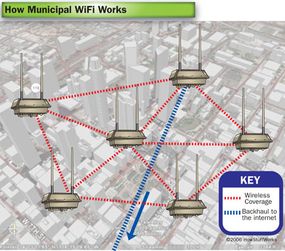
That's why most municipal wireless networks use a mesh rather than a hub and spoke. A mesh is a series of radio transmitters. Each transmitter is able to communicate with at least two others. They create a cloud of radio signals through the city. Signals travel from router to router through this cloud.
HowStuffWorks
In some networks, signals hop from one receiver to another until they reach a node that has a wired connection to the Internet. Other networks use backhaul nodes. These nodes do exactly what their name implies -- they gather up all the data from many transmitters and haul it back to the Internet by sending it to a router with a wired connection. Backhaul nodes are usually point-to-point or point-to-multipoint nodes. They can either connect one point to exactly one other, or they can connect one point to several points.
If you use your laptop to connect to the Internet in a mesh network, here's what happens:
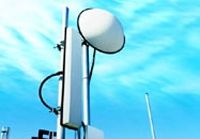
Some networks use WiMAX transmitters for backhaul.
Photo courtesy Intel
Your computer detects the nearby network, and you sign on.
The protocol that controls the mesh determines the best path for your data to follow. It plans the route that will make the fewest hops before reaching a wired connection or a backhaul node.
Your data follows the path that the protocol sets. When your data reaches a node that has a wired connection, it travels over the Internet until it reaches its final destination.
If you're out and about in a city with public access, you can probably do this with no extra equipment. But if you're trying to access the network from home, you may need a stronger radio and possibly a directional antenna. Although signals from the city network are strong enough to make it into your home, the signal from your computer may not be strong enough to make it out again. Most service providers take this into account and provide the necessary equipment for free or for a fee, much like they do with DSL or cable modems.
This system has several advantages over the hubs and spokes of ordinary hot spots. First, since there are fewer wires, it's less expensive. If a few nodes fail, others in the mesh can compensate for it. In addition to being far less expensive than running high-speed cable to every location in a city, it's a lot faster to build.
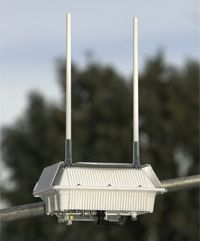
Municipal networks use routers like these mounted on light poles throughout the city.
Photo courtesy Tropos Network
When a city decides to built a wireless network, it generally issues a request for proposal (RFP). An RFP is simply a request for information from companies that are interested in building the network. While a city could theoretically build its own network, most choose to delegate that part of the process to a company that has experience in Internet and network technology.
Interested businesses respond to the RFP with a proposal that describes a plan for building and maintaining the network. The proposal includes everything from the number and type of radios to the final cost. The physical structure of the network has to take the size and layout of the city, tree cover, landscape and other factors into consideration. The proposal also includes who will end up owning, running and maintaining the network -- the city or the business.
In some of the earliest proposed networks, the cities themselves owned and controlled the networks. Businesses like ISPs and telecommunications companies objected to these plans. Their argument was that competition between municipalities and the private sector was unfair or even illegal.
Today, many existing and proposed networks follow one of the following four models:
The city owns the network, which is for city use only
The city owns the network, which is for city or public use
The city owns the network, and ISPs lease access to it, passing that access on to the public
A service provider owns and operates the network, providing access to the city, the public and even other service providers
The city reviews all of the RFPs, then decides which proposal to accept. EarthLink, for example, has been selected to build networks in Anaheim, California and Philadelphia, Pennsylvania and is a finalist in several other cities. EarthLink is also teaming up with Google to build a wireless network in San Francisco.
Exactly what the network ends up looking like depends on a few factors. The first is exactly what a city hopes to do with the network. A city-wide blanket of coverage that's open to everyone can look very different from a public safety network that will be open only to police officers and firefighters. (See "Wireless Applications" and "Public Safety" to learn more about what these networks can do.)
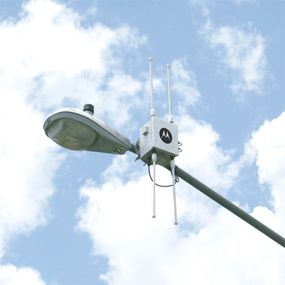
This Motorola node has radios for 2.4 GHz transmissions as well as 4.9 GHz public safety transmissions.
Photo courtesy Motorola
Different businesses' proposals can also vary widely depending on the hardware and protocols they use. EarthLink's projects combine mesh and point-to-multipoint networks. Most of its proposals incorporate radio transmitters on light poles throughout the city, which create the cloud of wireless signals. Radio antennas on tall buildings or towers also communicate to smaller antennas placed throughout the cloud. These point-to-multipoint antennas provide the backhaul, carrying the data from the cloud to the wired Internet.
Almost always, once a city has made a choice about who will build, run and maintain the network, the final step is a pilot program. A pilot program is like a preview or a test run of a smaller version of the network. It's generally a fraction of the size of the final project, and it lets the city to make sure the network is right for them.
Let's look at what a city can do with a wireless network once it's up and running.
Community Wireless and Disaster Recovery
Natural disasters and other catastrophic events can destroy a city's communications infrastructure, from phone lines to fiber optic cable. After Hurricane Katrina, government officials created a wireless network around one of the city's few remaining Internet connections. This allowed workers to communicate with each other and with officials in Washington, D.C. using e-mail and Voice over Internet Protocol (VoIP).
Advertisement
Wireless Network Applications and Public Safety
A municipal network can provide low-cost, high-speed access to the general population. Some cities have used this to justify the expense of the network. In theory, people who are no longer spending money on a high-speed connection will be able to put that money back into the local economy.
Organizations have created wireless networks in developing nations to provide Internet access in locations where traditional networks are impossible. Some U.S. cities hope to use their networks to close the digital divide. Philadelphia, Pennsylvania plans to supplement its network with low-cost computers for low-income families. Plans also include training teen-agers to provide tech support to the people in their communities. You can find out more about these plans through Wireless Philadelphia, the nonprofit organization overseeing the network.
Advertisement
Free or low-cost Internet access is great, but it's only a fraction of what a municipal network can do. In rural areas, wireless networks can give farmers real-time access to security cameras and controls for irrigation and other systems. Networks can make inexpensive Voice over IP (VoIP) phone calls more practical, which can save money for people, businesses and the government. Networks can also make city workers' jobs substantially easier with applications like automated meter reading. Building, fire and restaurant inspectors can file reports without returning to the office, cutting down on their travel time. This is another way that cities can see a return on their investment in the network - they save money on travel, equipment and fees paid for existing communications networks.
Networks can also give police and firefighters remote access to security cameras, blueprints, criminal records and other necessary information. They can let officers show witnesses mug shots or "virtual line-ups" at the scene of a crime. For applications like this, American cities can apply for funding from the Department of Homeland Security.
Public Safety Most people connect to a wireless network using the 2.4 GHz band of the radio spectrum. Public safety personnel can do this as well, using secure, encrypted connections. But they also have another option -- the 4.9 GHz band of the spectrum. This band is licensed. Not just anyone can get on it, and it's for public safety use only. Putting public safety traffic into its own channel keeps it from getting bogged down during heavy use of the network. Wireless transmitters must have separate 4.9 GHz radios to use this frequency.
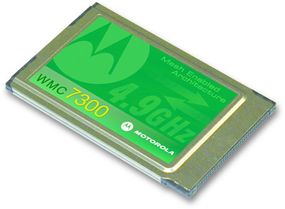
Public safety networks also have additional options in the radio technology they use. Motorola's Mesh Enabled Architecture (MEA®) systems originated from battlefield technology. MEA gives police officers, firefighters and others capabilities above and beyond an ordinary network.
MEA radios can create an ad-hoc network. MEA allows Multi-Hopping® -- a signal can move from user to user in the network rather than from the user to a node in the network. Each radio automatically detects the other radios, and a network automatically forms between them. The radios themselves act as routers or repeaters to pass the signal along. This means that officers with MEA-enabled radios can go into an area with no access to the rest of the network and still have access to one another. Media access control (MAC) filtering and encryption measures keep the network secure.
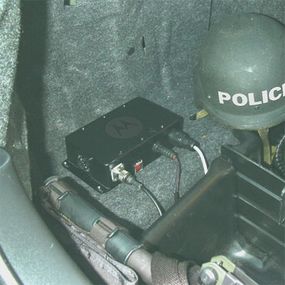
Vehicle-mounted modem
Photo courtesy Motorola
Imagine a town in which a tornado destroys the light poles that house the network's wireless routers. Power and phone lines fall as well. Ordinarily, this would severely limit communications. But with MEA radios, officers with vehicle-mounted modems can drive into the area and form a network with one another. Portable devices, like ruggedized laptops and PDAs, can use MEA-enabled wireless cards to communicate with the ad-hoc network. If one of these radios can connect to the ad-hoc and the mesh networks, it can form a bridge and connect the two.
MEA card
Photo courtesy Motorola
MEA-enabled equipment has some other capabilities, too. Most wireless networks can't determine the location of a specific user within a network. This is why many experts caution consumers about placing 911 calls from WiFi phones. But MEA technology grew out of battlefield technology that allowed the military to track soldiers' locations, even if they were out of the line of site of the GPS satellites.
MEA radios can measure the length of time it takes for an officer's signal to travel to three nodes, called time of flight. It then triangulates the officer's location. This can significantly reduce the amount of time it takes for crews to find firefighters who are still in burning buildings or to zero in on injured policemen. The process works on vehicles, too.
Finally, most wireless radios can maintain a signal at speeds up to 30 or 40 miles per hour (48-64 kilometers per hour). Many of these public safety radios can transmit at speeds of up to 250 miles per hour (402 kilometers per hour). Similar systems have been used in racing to send vehicle telematics to the pit crew.
Municipal networks are so new that there's no one standard or method for creating and using them. Not every network has separate parts of the spectrum for public safety, and not every network allows public access at all. Check out the links on the next page for more information on wireless networks on related topics, as well as links to sites where you can learn about the latest network deployments.
Pros & Cons
Municipal wireless networks have a lot of benefits, but not everyone is convinced that they're a good thing. In some states, municipal networks are illegal. Pending federal legislation may either clear the way for them or ban them entirely. Check out this map to see your state's stance [ref].
Here are some current arguments against the networks:
If a city owns the network, it has an unfair advantage against private businesses. This could cause a decline in competition and give the city a monopoly.
Internet access is a luxury rather than a necessity, so public funds should not be used to provide it.
Benefits like reducing cost and providing a service that will attract new businesses haven't been proven.
Some previous deployments have failed due to lack of interest or faulty equipment.
The equipment itself will one day be obsolete and need replacement.
Advertisement
Frequently Answered Questions
How do I install public WiFi?
There is no one-size-fits-all answer to this question, as the installation process for public WiFi can vary depending on the specific router and network setup. However, in general, installing public WiFi typically involves connecting the router to the modem and configuring the router to broadcast the WiFi signal.
How does municipal wireless network work?
A municipal wireless network is a network that provides wireless Internet access to the public in a given area. The network is typically created and managed by a city or other municipality.
Bast, Joseph L. "Municipally Owned Broadband Networks: A Critical Evaluation." Heartland Institute, November 1, 2002. http://www.heartland.org/Article.cfm?artId=10686&CFID=2683416&CFTOKEN=48657824
"Digital Community Best Practices."Intel. http://www.intel.com/business/bss/industry/government/digital-community-best-practices.pdf
"HotSpot Market's Retaining its Heat." InStat, October 12, 2004. http://www.instat.com/press.asp?ID=1103&sku=IN0401289MU
"Mesh Networks Products and Solutions." Motorola, 2005.
"Metro Scale Wi-Fi Mesh Networks." Tropos.
Motorola's Mobile Mesh Networks Technology http://www.motorola.com/governmentandenterprise/northamerica/en-us/public/functions/browsesolution/browsesolution.aspx?navigationpath=id_804i/id_2523i/ssone2
"Not in the Public Interest -- The Myth of Municipal WiFi Networks." New Millennium Research Council, February 2005. http://www.newmillenniumresearch.org/archive/wifireport2305.pdf
Penenberg, Adam L. "The Fight over Wireless." Slate, October 24, 2005. http://www.slate.com/id/2128632/
WiFi Net News http://www.wifinetnews.com/
"The Wireless City." Intel. http://www.intel.com/business/bss/industry/government/wireless_city.pdf
Wolter, Charlotte. "New Orleans, BellSouth in Wi-Fi VoIP Tussle." New Telephony, March 22, 2006. http://www.newtelephony.com/news/63h2284939.html
Thank You
For this article, we interviewed Cole Rienwand, Vice President of Product and Marketing Strategy for Municipal Wireless at EarthLink. We also spoke to Pam Benke, Marketing Communications Manager; Michael Fabbri, Director; and Rick Rotundo, Director of Marketing; all from Motorola. Thanks to all of them and to the other experts we spoke to at MuniWireless 2006 in Atlanta, Georgia.
Cite This!
Please copy/paste the following text to properly cite this HowStuffWorks.com article: